Workshop: Philip Stopford's MISSA DEUS NOBISCUM
9:30am, Sat, 13 Mar 2027
Share: 

- Event Details
-
Type of event: Workshop Start time: 9:30am End time: 4:30pm Venue: Sr Herbert's Parish Centre
148 Broadway, Chadderton, Oldham, OL9 0JYSee map below Tickets: 
Description: 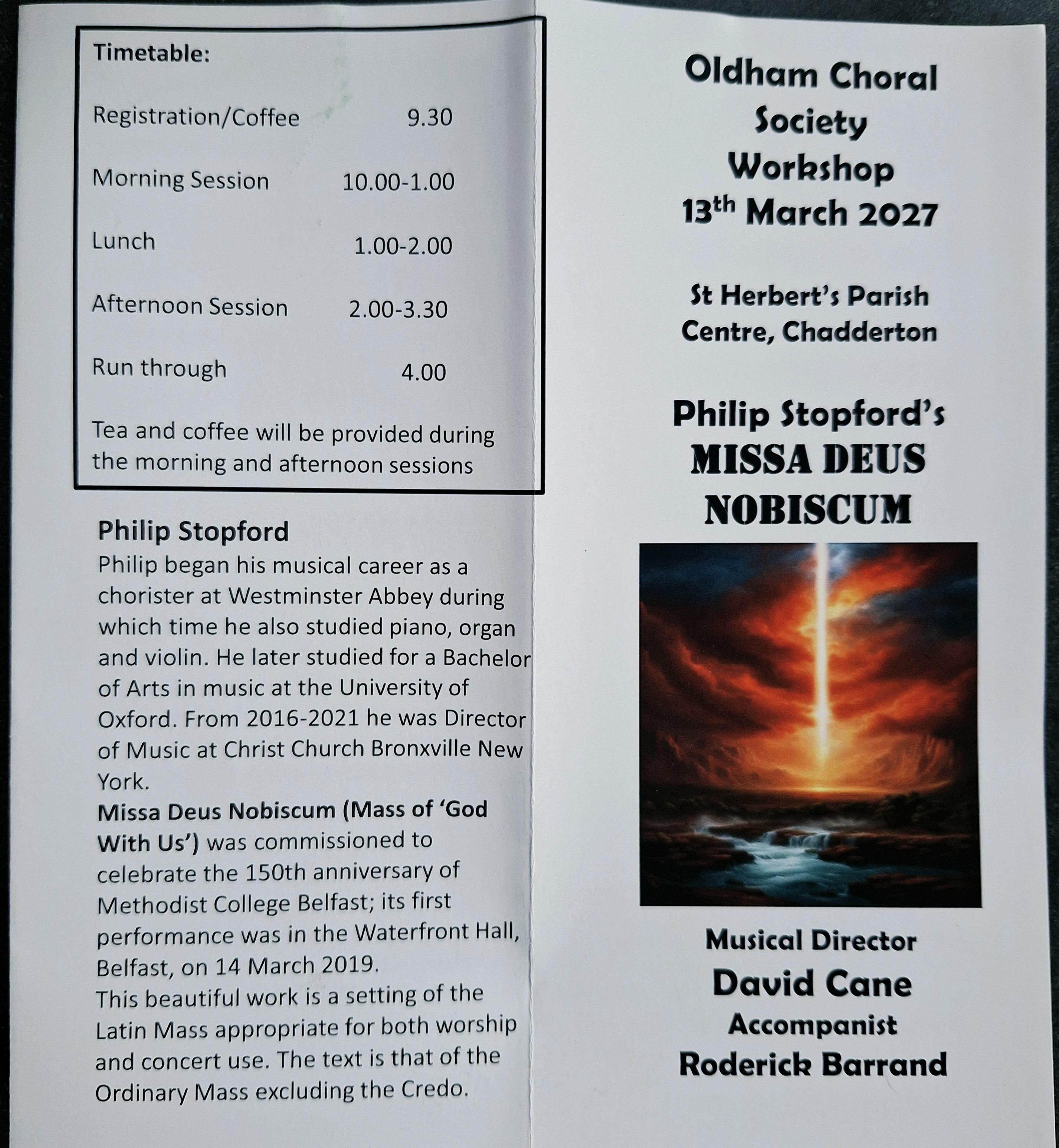
The music of Philip Stopford is a product of the English choral tradition, yet much of it is also aimed at the American market, not least because Stopford has an American publisher and worked for over five years as a conductor in the state of New York. Stopford’s Missa Deus nobiscum (Mass of ‘God with us’) was written in 2018 and is a fount of memorable tunes and colourful orchestration. Crucially, all of Stopford’s music is dynamically amenable – it sounds familiar even on first listening. Most of Stopford’s orchestrations are made after the event as a textural expansion of a pre-existing organ or piano part, but the Missa Deus nobiscum was conceived from the outset as a piece for choir and orchestra. While some sections have been performed as part of the liturgy, the four-movement Gloria in excelsis is too expansive for inclusion in most celebrations of the Roman Mass or Anglican Eucharist: Missa Deus nobiscum is at root a sacred concert work. Written for the 150th anniversary of the Methodist College in Belfast, the vocal parts are approachable, the orchestral parts integral and colourful, and the soprano soloist adds scintillating glamour to the whole. The recurring melody of the Kyrie is inclusive and stirring, while the central ‘Christe’ section allows the choir to sensitise the movement with vibrant a cappella singing. The additive rhythms of the outer movements of the Gloria are energetic and ebullient, in contrast to the monolithic Domine Fili movement, which acts as the fulcrum for the whole Mass. In both the Sanctus and the upper-voice Benedictus, the Osanna text is woven into the effect of the preceding music rather than standing alone as an isolated shout of jubilation. The Agnus Dei which follows makes measured and inexorable progress towards its visceral cry for peace at the end of the work. In Stopford’s hands, the setting of the Mass is a journey rather than a sequence of set pieces, although the work’s architecture does not rely on charting its progress with selfreferential motifs (except within the opening movement, where the tripartite text is clearly delineated).
Description from the Naxos recording.